- He was taken under the wing of Behrens and was hired for them in early 1908
- He played tennis so intensely that he developed a "wrist and hand tremor that furthered his already minimal ability to draw."
- Gropius decided to start his own firm in 1910 after working with Behrens, taking his assistant, Adolf Meyer, with him.
- His students were taught by him to immerse themselves in deep thought and discussion, being made to wear certain costumes, shave their heads, and using various diets, powders, and oils.
- He wanted to maintain a "private architectural practice" so he located his office inside the Bauhaus School.
- One of his main purpose of designing was to "design all functional objects."
- Starting in 1933 because of the War, Gropius fled to England and then the United States to do even more extraordinary work until his death.
- One of his goals of design was to "raise the level of product design by combining art and industry."
- After coming to the United States, he because the head of the architecture faculty at Harvard University.
- Gropius marked his work by "simplicity of shape, elimination of surface decoration, and the extensive use of glass."
http://www.germanheritage.com/biographies/atol/gropius.html
http://www.cartage.org.lb/en/themes/Arts/Architec/20centuryArch/arcitects/G/gropius.htm

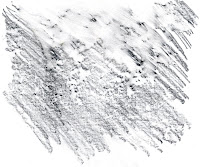 This is a texture I found in the Knowlton School of Architecture on 1-19-11. It is the texture of one of the concrete walls in the building and I found it interesting because even thought the building is a fairly new one, there are still exposed and bare walls that look old and beat down.
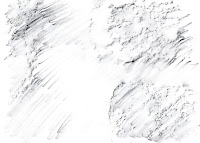 This is the texture of one of the stone pillars outside of Smith Hall on 1-19-11. I captured this texture because this is one that I feel is very overlooked and doesn't get much attention at all.
 This texture is one of a leaf from a bush outside of the Central Classroom Building on 1-19-11. I chose this texture because it is one of an infinite amount of different types of leaves that very much go overlooked.
 This is a sketch of a fence outside of Smith Hall that I did on 1-19-11. I illustrated the pattern of this fence because of how simple, yet useful it is.
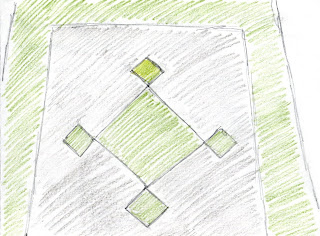 This is the pattern that is on the floor of Smith Hall on 1-19-11. Even though I walk on it multiple times a day, I never took the time to study and look at it more in detail.
 This is the texture that is on my desk lamp in my room on 1-19-11. I captured this texture because of how it may resemble fish scales or some type of snake skin.
 This is the heat radiator in my room I rubbed on 1-18-11. I got this pattern because it is one of many places this type of patter is seen all over.
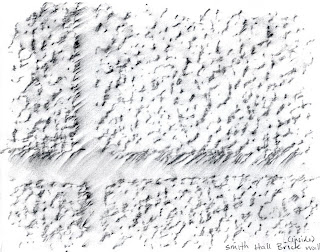 This is the pattern and texture of a brick wall. I captured this texture in Smith Hall on 1-19-11 because of how often it is seen or come in contact with, but how little residence notice it.
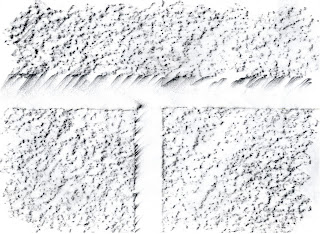 This is the texture of the brick wall that covers the outside of Smith Hall on 1-19-11. Similar to other patterns and textures, I chose this one because of the fact that it can be seen on the majority of buildings and it hardly has been changed or altered in many years.
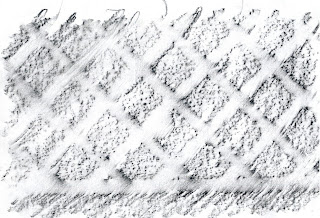 This it the pattern of the steps on the stairs in Smith Hall on 1-19-11. This pattern interested me because of how simple it is, but like the fence, it serves a very useful purpose in every day life.